This Maldives water sports holiday gives each of four days its own experience. One day you fly above the water, the next you go beneath it, on the third you paddle across the lagoon, and on the fourth you do nothing at all — and that fourth day is the most deliberate part of the whole programme. Four nights, five days in total.
The logic behind the order of the days
The days are not sequenced at random. The highest-adrenaline activity comes first, the technical and calm one in the middle, and recovery at the end. There are two reasons for that.
The first is safety. Scuba diving is never scheduled on the last day: you must wait at least 18 hours after a dive before flying, otherwise the drop in cabin pressure creates a decompression risk with the nitrogen still in your blood. That is why the dive is fixed to day two — three full days clear of the return flight.
The second is learning. Doing flyboard or seabob on day one lets your body settle into the water and find its balance; breath control and ear equalisation on the dive the following day come far more easily as a result. Day three's SUP session is low-intensity but technical, which is exactly what shakes off the previous two days.
Day 1 — Flyboard or Seabob
Flyboard lifts you several metres above the sea by jetting high-pressure water through a board strapped to your feet. It looks harder than it is: the instructor keeps the pressure low for the first ten minutes while you learn nothing but balance. Most guests are standing above the water by the halfway point of the session.
Seabob goes the other way. Holding a powered underwater scooter, you drop below the surface and travel along the reef at the same speed as the fish. Physically far less demanding, but a much more immersive underwater experience.
The choice between them is made on the day, not at booking. The reason is practical: flyboard is sensitive to wind and swell, so the instructor looks at the sea state and tells you which is safe. If conditions allow, the choice is entirely yours.
Day 2 — Scuba diving
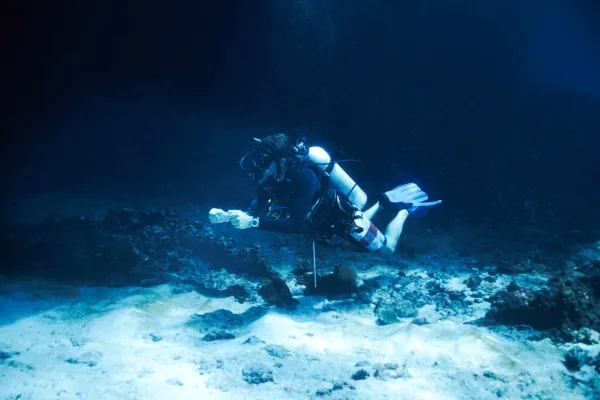
The Maldives is one of the world's great dive destinations, and not only because of the clarity. The atoll structure funnels constant current between the reef walls and the lagoons, which drives a dense food chain and heavy marine traffic along with it. Visibility reaches 25–30 metres in the dry season.
Certified divers get a reef wall or channel dive; just bring your logbook. Guests without certification do a discover scuba dive: around an hour of theory and equipment training in the pool or shallow water, then a one-to-one dive with the instructor to a maximum of 12 metres. No certification required.
A health declaration before diving is mandatory. Medical clearance is required for cardiovascular conditions, asthma, ear or sinus problems, uncontrolled blood pressure or pregnancy — this is applied without exception, as an international diving standard rather than a resort rule.
Day 3 — Stand-up paddleboard and focus
The pace drops deliberately on day three. The SUP session starts early, while the lagoon still looks like glass. Paddleboarding seems easy at a glance; in practice, standing on the board is a continuous balance exercise made of micro-corrections, and it loads the core heavily.
The second half of the session is the focus segment: the instructor works on matching your paddle cadence to your breathing. This is the side of SUP that gets mentioned alongside yoga and meditation — paddling at a steady rhythm with your gaze fixed on the horizon produces a noticeable mental calm surprisingly quickly. Experienced paddlers can take a longer lagoon loop instead.
Day 4 — Active rest
Day four has no schedule, and that is intentional. A body that has done water sports three days running needs to recover; packing all four days full is the most common way to come home saying you never actually rested.
Active rest does not mean doing nothing: free swimming in the shallows, snorkelling the house reef, walking the island, a hammock, or the resort's spa. If you feel good, an extra SUP outing or a second dive can be requested — both are chargeable and arranged locally.
Accommodation, transfers and flights
Four nights with breakfast included. Transfers are organised from arrival in Malé; depending on your flight time and the island, you continue by speedboat or seaplane. Seaplanes only operate in daylight, so a night arrival can require an overnight stop in Malé — this is set out for you in advance along with the flight options.
Turkish passport holders travel without a visa and receive a free 30-day permit on arrival. The passport must be valid for at least six months from the return date.
Why does the price move with the date?
This is a private tour. Resort rates in the Maldives can double between seasons, and the gap between New Year or peak holiday weeks and the May–October monsoon is wide. Dive site availability is seasonal too — manta season and whale shark activity are not the same every month.
So the figure shown here is a starting price. Leave your dates and group size and the programme is built around them, with a firm quote back. Requesting one is free and commits you to nothing.
Frequently asked questions
I'm not a certified diver. Can I join?
Yes. Guests without certification do a one-to-one discover scuba dive with the instructor; theory and equipment training are included and no certificate is needed.
Will I do flyboard or seabob?
That is decided on the day, based on sea conditions. If the sea allows, the choice is entirely yours.
Can I fly after diving?
You must wait at least 18 hours. The programme is built around that rule: the dive is fixed to day two, leaving three full days before the return flight.
Do I need to be able to swim?
Basic swimming ability is required for flyboard and diving. SUP and snorkelling can be done with a buoyancy aid.
Can I bring children?
The minimum age is 12, which comes from the scuba dive. For younger children an extra snorkelling and SUP session can replace the dive — just mention it when you send your request.